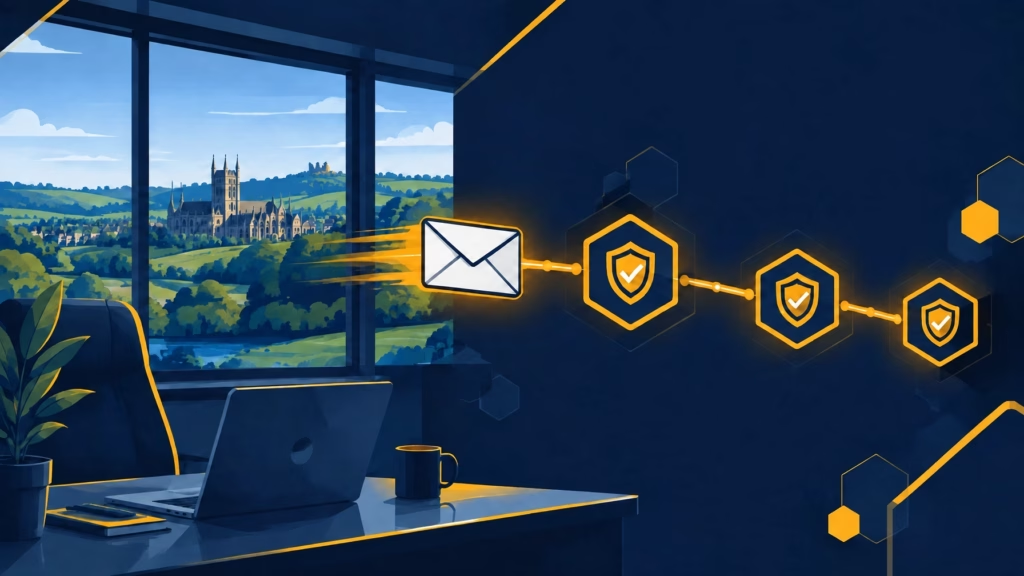
A cyber security alert is only useful if someone can review it, understand what it means and take the right action. For many small businesses, managed SOC services Hampshire organisations rely on become relevant at exactly this point.
Your IT provider may monitor systems during office hours. Your Microsoft 365 account may generate security notifications. Your endpoint protection may flag suspicious activity. But what happens when an important alert appears at 10.30pm, or when several minor warnings combine to reveal a genuine attack?
This is where managed SOC services Hampshire businesses can access provide additional value. A managed Security Operations Centre (SOC) gives your organisation access to continuous security monitoring, specialist alert investigation and agreed incident escalation without the cost of building a full internal security team.
What are managed SOC services Hampshire businesses should understand?
A Security Operations Centre is a team of security analysts, supported by specialist technology, who monitor systems for suspicious activity. A managed SOC provides this capability as an outsourced service.
The service may monitor signals from:
- Microsoft 365 and cloud applications
- Laptops, desktops and servers
- Firewalls and network infrastructure
- Email security systems
- Identity and user accounts
- Cloud platforms and business applications
- Endpoint Detection and Response (EDR) tools
The important difference is not simply that alerts are collected. Qualified analysts triage them. Triage means assessing an alert to decide how serious it is, whether it is likely to be a false positive and what action should follow.
How is this different from ordinary IT support?
Traditional 9-to-5 IT support is primarily focused on helping users and maintaining technology during agreed business hours. This might include fixing a failed laptop, resolving a Microsoft 365 problem or setting up a new user.
Reactive break/fix support goes one step further towards the past. You contact the provider when something has already stopped working, and they investigate the problem afterwards.
Continuous security monitoring is different. It is focused on detecting and investigating suspicious activity before it becomes a major business disruption. It also extends beyond the working day.
These services can work together:
- IT support keeps your technology working.
- Proactive maintenance helps prevent avoidable faults.
- Security monitoring looks for signs that someone is attempting to compromise your systems.
- Incident response helps contain and recover from a genuine security event.
A managed SOC does not replace your internal team or IT provider. It gives them additional visibility, expertise and support when a security issue needs attention.
5 signs your business should consider managed SOC services Hampshire
1. Alerts are generated, but nobody has time to investigate them
Security tools can produce a large number of alerts. Some may relate to a blocked phishing email. Others may involve a suspicious login, unusual file activity or a new process running on an endpoint.
The difficulty is that an alert is not the same as an investigation.
If alerts are forwarded to a shared inbox that nobody checks consistently, your business may have the appearance of monitoring without the protection that monitoring should provide. Even when someone does see the alert, they may not have the time or expertise to understand its significance.
Ask yourself:
- Who reviews security alerts each day?
- How quickly are high-risk alerts investigated?
- Can anyone correlate activity across multiple users and devices?
- Is there a documented process for deciding what happens next?

A managed SOC helps by filtering and prioritising alerts. Analysts investigate the context, identify patterns and escalate the events that require your attention. This reduces alert fatigue and helps your team focus on the risks that matter.
Pro tip: Do not measure your security solely by the number of alerts received. Measure whether important alerts are investigated promptly and consistently.
2. Your business has no out-of-hours incident response
Cyber attacks do not follow office hours. A compromised account, ransomware infection or suspicious administrator login can occur overnight, at the weekend or during a bank holiday.
Consider Diana, who runs a 12-person digital marketing agency in Winchester. Her team relies on Microsoft 365, cloud collaboration tools, a CRM, remote working and sensitive client campaign data.
At 11.48pm on a Friday, an attacker signs into a user’s Microsoft 365 account from an unfamiliar location. Shortly afterwards, they begin accessing shared files and creating email forwarding rules.
Diana’s IT provider offers responsive support during normal business hours. However, nobody is actively reviewing the security alert that night. By Monday morning, the attacker may have had more than two days to access information, impersonate the employee or send convincing messages to clients.
With 24/7 cybersecurity monitoring, a managed SOC can review the alert outside office hours and follow the agreed escalation process. Depending on the evidence and service scope, the analyst may notify Diana, her IT provider or a nominated contact so that access can be restricted and the incident investigated.
This does not mean every alert triggers a 2am emergency call. It means genuine threats are not left waiting simply because the office is closed.
3. Your systems are monitored separately, with no joined-up visibility
Modern businesses use a mixture of services. Microsoft 365 may be managed in one portal, endpoint protection in another, the firewall in a third and cloud applications elsewhere.
Each system can provide useful information. The problem is that isolated alerts rarely show the complete picture.
For example:
- A user receives a suspicious email.
- The user signs into Microsoft 365 from an unusual location.
- A laptop begins downloading an unfamiliar application.
- The firewall records a connection to a suspicious destination.
Viewed separately, each event might appear low risk. Viewed together, they could indicate a compromised account or an active attack.

A managed SOC or managed security monitoring service can bring these signals together. This joined-up visibility helps analysts identify relationships between events and investigate activity across your environment. For many firms, managed SOC services Hampshire providers deliver are valuable because they turn separate alerts into one clearer security picture.
This is especially valuable for businesses with remote workers, cloud-first systems and no dedicated security team. A SOC for small business should be proportionate, practical and focused on the systems that your organisation actually depends on.
4. You cannot confidently distinguish a false positive from a genuine attack
Security tools are designed to be cautious. That is sensible, but it means some alerts will turn out to be harmless.
An unfamiliar login could be an employee travelling. A new application could be legitimate business software. A large file transfer could be normal campaign work. Equally, those same events could be signs of account compromise or data theft.
Without specialist context, businesses may make one of two dangerous mistakes:
- Ignore a real threat because it looks inconvenient or unusual.
- Treat every alert as an emergency, wasting time and creating unnecessary disruption.
Security analysts assess factors such as the user, device, location, timing, behaviour and related events. They can then classify the alert and recommend proportionate action.
Important: 24/7 monitoring does not mean every alert receives an emergency response. Analysts triage alerts according to risk. Genuine threats are escalated according to agreed procedures, while low-risk or expected activity can be documented and closed.
Your provider should explain:
- Which alerts they investigate.
- How they assess severity.
- What counts as a confirmed incident.
- Who makes the final business decision.
- Whether containment actions require your approval.
5. Your insurance, contracts or compliance expectations require stronger monitoring
Cyber insurance providers, customers and regulators increasingly expect businesses to demonstrate that cyber security is actively managed.
Your organisation may need stronger monitoring and documented response because:
- A cyber insurance policy requires specific security controls.
- You are working towards or maintaining Cyber Essentials.
- Customer contracts require evidence of security measures.
- You handle personal, confidential or commercially sensitive information.
- Your sector has regulatory or contractual reporting expectations.
- A customer or procurement team has asked for evidence of incident response.
A managed SOC is not a substitute for Cyber Essentials, a risk assessment or an incident response plan. It can, however, support those wider controls by providing monitoring, investigation records and reports.
The NCSC’s small organisations guide to cyber security recommends practical measures such as protecting devices and accounts, using backups and preparing for incidents. Its incident management guidance also stresses the importance of preparation, response and recovery.
Review your requirements regularly. Insurance policies, customer contracts and security standards can change, and your technology environment will change as your business grows.
What should you ask a managed SOC provider?
Before choosing a provider, ask clear questions about what the service includes.
Coverage and monitoring
Confirm:
- Is monitoring genuinely available 24/7?
- Which systems are covered?
- Are Microsoft 365, endpoints, firewalls and cloud services included?
- Are logs collected centrally?
- How long are logs retained?
- Can the service scale as your business grows?
Alert triage and escalation
Ask how alerts are assessed and:
- What severity levels are used?
- How quickly are high-risk alerts reviewed?
- How will you be contacted?
- Are escalation contacts tested?
- What happens if nobody responds?
- Can your internal IT provider be included in the process?
Incident response
Clarify whether the service includes:
- Investigation and evidence gathering
- Account isolation or disabling
- Endpoint containment
- Support with password resets and access reviews
- Guidance on communications and reporting
- Post-incident recommendations
- Assistance with recovery, or only detection and notification
Do not assume that “monitoring” automatically includes full remediation. Make sure responsibilities are written down.
Reporting and pricing
Request example reports and check whether they show:
- Alerts investigated
- Incidents escalated
- Actions taken
- Outstanding recommendations
- Trends and recurring weaknesses
- Relevant evidence for insurance or customer reviews
Pricing should be transparent. Ask whether costs are based on users, devices, log volume, data retention or incident activity. Find out what is included and what would be charged separately.
How BITSmart can help your Hampshire business
BITSmart supports small and growing businesses across Winchester, Romsey, Southampton, Eastleigh, Basingstoke and the wider Hampshire area.
Our approach combines practical IT support Hampshire businesses can rely on with proactive cyber security measures. Depending on your needs, this can include Microsoft 365 monitoring, endpoint protection, managed EDR with SOC-backed monitoring, patch management, user awareness training and incident support.
We will help you understand what is being monitored, what your team needs to do and where a specialist security monitoring arrangement adds value. The aim is not to create unnecessary complexity. It is to give your business a clearer view of risk and a more reliable response when something unusual happens.
If you are looking for cybersecurity services Winchester businesses can access through a local, plain-English partner, we would be happy to discuss your current setup.
Book a Call
You do not need to build an in-house SOC to improve your detection and response capability. Start by reviewing your current alerts, out-of-hours arrangements and provider responsibilities.
Book a Call with BITSmart to discuss whether managed SOC services Hampshire businesses use would be proportionate for your organisation. We can review your requirements, identify gaps and explain practical next steps without unnecessary pressure.
The goal is simple: detect important threats earlier, respond with confidence and keep your business moving.